

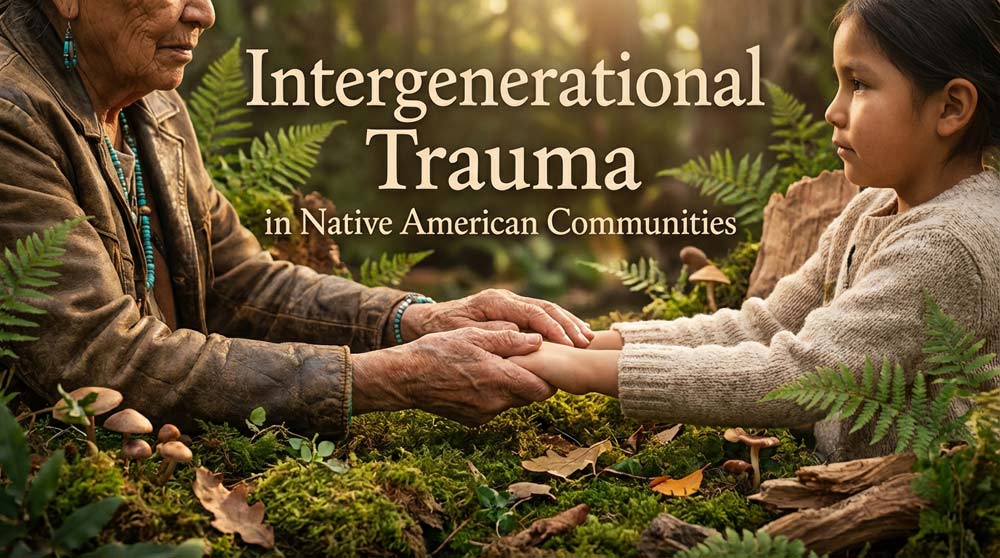
The Wounds That Do Not Begin With Us
When people speak about trauma, they often speak in singular terms — a single event, a single experience, a single hardship.
But in many Native American communities, trauma did not begin with one person. It did not begin with one generation. It moved quietly from parent to child, grandparent to grandchild, sometimes without being named.
Intergenerational trauma — sometimes referred to as historical trauma — describes the emotional and psychological wounds passed down through families and communities who have endured collective hardship. Researchers such as Dr. Maria Yellow Horse Brave Heart, one of the leading scholars on Native American historical trauma, have written extensively about this phenomenon and its impact on Indigenous communities. (See: Brave Heart’s work summarized through the Indian Health Service and related academic publications: https://www.ihs.gov)
For Native Americans, that collective hardship includes forced relocation, boarding schools, land dispossession, cultural suppression, and systemic poverty.
Those events did not simply end when policies changed.
They lingered.
Boarding Schools and Cultural Suppression
From the late 1800s into the 20th century, Native children were taken from their families and sent to boarding schools designed to strip them of language, culture, and identity. The motto often associated with this era — “Kill the Indian, save the man” — reflects the assimilationist intent of federal policy.
The U.S. Department of the Interior has formally acknowledged the scope and damage of the Federal Indian Boarding School system in recent reports documenting widespread abuse and generational impact. (See: https://www.doi.gov/priorities/strengthening-indian-country/federal-indian-boarding-school-initiative)
Children who were punished for speaking their language grew into adults who sometimes did not teach that language to their own children.
Affection was replaced with institutional discipline.
Cultural identity was replaced with enforced conformity.
When those children became parents, they often carried wounds they did not have words for.
And so trauma moved forward.
Poverty and Structural Inequality
The economic realities facing many Native communities today are not disconnected from historical policy.
According to the U.S. Census Bureau, Native American communities continue to experience poverty rates significantly higher than the national average. (https://www.census.gov)
Limited access to healthcare, education disparities, and underfunded infrastructure contribute to cycles that are difficult to break without structural change.
Poverty alone is not trauma. But poverty layered onto historical displacement and cultural erasure creates stress that affects families across generations.
Children raised in environments shaped by scarcity absorb that stress, even if no one names it.
Alcohol and Coping
It is important to speak carefully here.
Alcohol misuse in Native communities has often been misrepresented or stereotyped. In reality, data from the National Institute on Alcohol Abuse and Alcoholism shows that while some Native populations experience higher rates of alcohol-related harm, the issue is complex and tied to broader socioeconomic and historical factors. (https://www.niaaa.nih.gov)
When trauma is unaddressed, coping mechanisms can become destructive.
Alcohol did not arrive in Native communities as part of traditional life. It was introduced through colonial contact. Over time, it became both a symptom and a response — a way of numbing pain rooted in historical upheaval.
But trauma is not destiny.
And neither is addiction.
Trauma as Memory in the Body
Research in psychology and epigenetics suggests that trauma can influence stress responses across generations. Studies published through institutions such as the National Institutes of Health discuss how prolonged stress and adverse childhood experiences shape long-term health outcomes. (https://www.nih.gov)
While the science continues to evolve, what many Native families already understood is this:
Pain echoes.
Children raised in environments marked by unresolved trauma often develop hypervigilance, early maturity, and a heightened sense of responsibility. They learn to read rooms. They learn to anticipate tension.
Sometimes they become strong too soon.
That strength is survival.
But survival is not the same as healing.
Healing and Cultural Reclamation
Intergenerational trauma is not the end of the story.
Cultural reclamation has become one of the most powerful tools for healing in Native communities. Language revitalization programs, ceremony, storytelling, and community-led wellness initiatives are helping to reconnect younger generations with identity that was once suppressed.
The Indian Health Service and tribal behavioral health programs increasingly incorporate culturally grounded healing practices into treatment approaches. (https://www.ihs.gov/behavioralhealth)
Storytelling plays a central role in that process.
As an Indigenous storyteller, I believe that naming history honestly is part of breaking cycles. When we understand where pain originated, we can stop blaming ourselves for wounds we did not create.
Strength Passed Down Too
It would be incomplete to speak only of trauma without speaking of resilience.
The same generations that carried hardship also carried knowledge. They carried language. They carried ceremony. They carried survival skills rooted in land and community.
Resilience travels through families just as powerfully as trauma does.
Native communities endured policies designed to erase them. They are still here.
That is not accidental.
It is strength.
Moving From Awareness to Responsibility
Understanding intergenerational trauma in Native American communities requires more than sympathy. It requires responsibility — both within and outside Indigenous communities.
For Native families, it means:
• Seeking healing without shame
• Talking openly about history
• Reconnecting with culture
• Supporting younger generations
For institutions and policymakers, it means:
• Acknowledging historical harm
• Supporting culturally informed healthcare
• Investing in Native education and infrastructure
• Respecting tribal sovereignty
Trauma that was created collectively must be addressed collectively.
Why This Conversation Matters
As a Native American author, I do not write about intergenerational trauma to reopen wounds. I write about it to place pain in context.
When we understand that certain struggles did not begin with personal failure, we create space for compassion — both toward ourselves and toward our elders.
We stop asking, “What is wrong with us?”
And begin asking, “What happened to us?”
That shift changes everything.
Because what happened can be understood.
And what is understood can begin to heal.